

Quick Summary
- Sciatica is caused by nerve compression in the spine; piriformis syndrome is caused by a buttock muscle compressing the same nerve outside the spine.
- Sciatica pain typically starts in the lower back and extends below the knee; piriformis syndrome pain usually begins in the buttock and rarely passes the knee.
- True sciatica frequently causes numbness, tingling, and leg weakness; piriformis syndrome produces milder neurological symptoms.
- Diagnosis relies on physical tests: the straight leg raise for sciatica, the FAIR and FABER tests for piriformis syndrome.
- Most cases of both conditions improve with conservative treatment over a period of weeks with consistent care.
Piriformis syndrome vs sciatica: both cause sharp, radiating leg pain, but the source differs. Sciatica results from sciatic nerve compression in the spine, typically from a herniated disc or spinal stenosis. Piriformis syndrome is caused by a tight muscle in the buttock that irritates the same nerve from outside the spine. Knowing which condition you have is the first step toward effective relief. That shooting pain down your leg can be debilitating, and the two conditions demand entirely different treatments. Sciatica is among the most common causes of radiating leg pain, affecting a large share of adults over their lifetime, while piriformis syndrome accounts for a meaningful portion of sciatica-like presentations. In this guide, you’ll learn how to distinguish between the two, understand their causes, and find targeted relief strategies for each condition.
Understanding Sciatica Pain and Its Causes
Sciatica pain refers to discomfort that radiates along the path of the sciatic nerve, which branches from your lower back through your hips and buttocks and down each leg. The sciatic nerve is the largest and longest nerve in the human body, formed from five nerve roots in the lower spine. When it is compressed or irritated anywhere along its path, the result is the characteristic pain of sciatica. This condition typically affects only one side of the body.
According to the Mayo Clinic, sciatica most commonly occurs when a herniated disk, bone spur on the spine, or spinal stenosis (narrowing of the spinal canal) compresses part of the nerve. Herniated or slipped discs account for about 90% of cases. Pain can range from mild aching to sharp, burning sensations, often worsening with prolonged sitting, coughing, or sneezing. Numbness, tingling, or muscle weakness in the affected leg are also common symptoms. Age-related spinal changes affect people most between ages 30 and 50, and jobs that require twisting, heavy lifting, or prolonged sitting all raise your risk. Data from the National Institutes of Health shows that smokers are approximately 1.5 times more likely to develop sciatica than non-smokers. True sciatica is a symptom of an underlying condition, not a diagnosis in itself.
Tip: Keep a pain journal noting when your symptoms occur, their intensity, and what activities trigger or relieve them. This information helps your healthcare provider determine the cause of your discomfort more accurately.
What Is Piriformis Syndrome?
Piriformis syndrome is a neuromuscular disorder that occurs when the piriformis muscle, located deep in the buttock beneath the gluteal muscles, spasms or tightens and compresses the sciatic nerve. Unlike true sciatica, the compression happens outside the spinal column. The piriformis muscle connects the lower spine to the upper femur and plays a key role in hip rotation and stability. In some people, the sciatic nerve passes through the piriformis muscle rather than beneath it, making those individuals more susceptible to this condition.
According to JAOA published research, piriformis syndrome causes approximately 6-8% of sciatica-like cases. The condition is more prevalent in women than in men, possibly due to anatomical differences and hormonal factors. Common causes include direct trauma to the buttock, repetitive hip rotation from running or cycling, prolonged sitting with a wallet in the back pocket, and weak gluteal muscles. When the glutes don’t function properly, the piriformis compensates by working harder, which leads to tightness and nerve irritation. Pain typically begins in the buttock and may radiate down the back of the thigh, but it rarely extends below the knee. Unlike true sciatica, piriformis syndrome usually doesn’t cause significant neurological symptoms like severe numbness or muscle weakness in the leg.
Tip: The FAIR test (Flexion, Adduction, and Internal Rotation) can help identify piriformis involvement. Lie on your unaffected side with the affected hip and knee flexed, then have someone gently press your knee downward while you resist. Pain during this maneuver suggests piriformis syndrome.
Key Differences Between Piriformis Syndrome and Sciatica
The most important difference between piriformis syndrome and sciatica is where nerve compression occurs. In true sciatica, the sciatic nerve is compressed within the spine, typically by a herniated disc or spinal stenosis. In piriformis syndrome, the compression happens in the buttock, entirely outside the spinal column. Research from Johns Hopkins School of Medicine indicates that accurate differentiation between these conditions improves treatment outcomes and reduces unnecessary interventions.
Pain patterns also differ significantly. In true sciatica, pain typically originates in the lower back and radiates through the buttock and down the back of the leg, often extending below the knee and sometimes into the foot. The pain follows a specific dermatome (the skin area supplied by the compressed nerve root). Piriformis syndrome pain usually starts in the buttock and may travel down the back of the thigh, but it rarely passes the knee. Positional triggers provide useful clues: piriformis syndrome pain typically worsens with sitting and improves with standing or walking, while true sciatica can be aggravated by both positions. True sciatica more frequently causes pronounced numbness, tingling, and muscle weakness in the leg, and in severe cases can lead to foot drop or loss of bladder and bowel control. Piriformis syndrome causes milder neurological symptoms, and significant muscle weakness is rare. Spinal MRI often shows visible abnormalities in true sciatica but typically appears normal in piriformis syndrome.
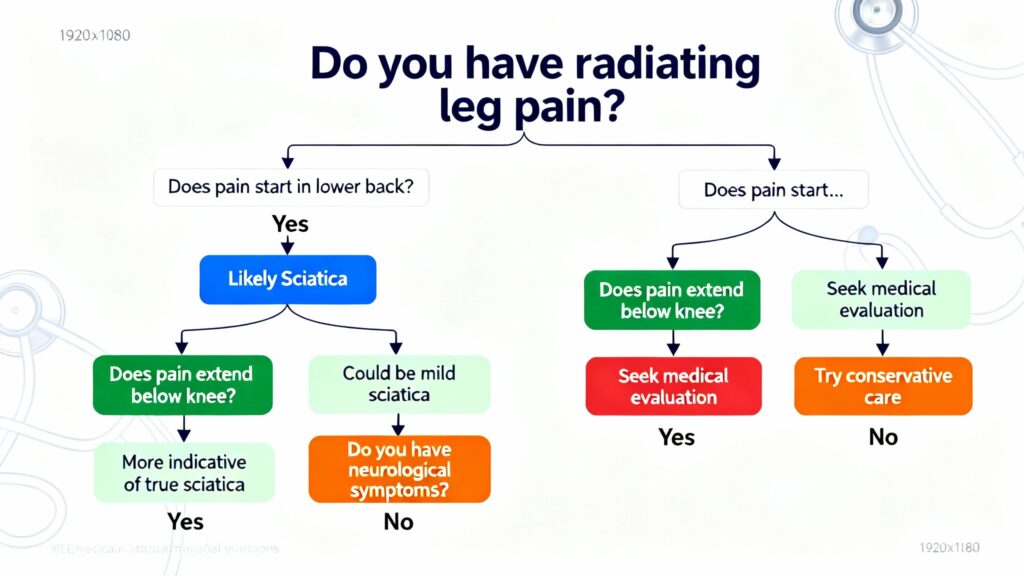
Tip: Track exactly where your pain starts and how far it radiates. True sciatica often extends below the knee, while piriformis syndrome pain typically stays above the knee. This simple observation provides valuable diagnostic clues.
How Each Condition Is Diagnosed
Accurate diagnosis starts with a thorough medical history and physical examination. A careful history and physical exam can identify the cause of sciatica-like symptoms in the majority of cases, consistent with established orthopaedic evaluation standards. Your healthcare provider will ask about the location, intensity, and duration of your pain and any factors that worsen or relieve it. They’ll also ask about recent injuries, occupational factors, and lifestyle habits that might contribute to your symptoms.
For true sciatica, the straight leg raise (SLR) test is a cornerstone of evaluation: you lie on your back while a provider slowly lifts the affected leg, and pain below the knee when the leg is raised between 30 and 70 degrees suggests true sciatica. For piriformis syndrome, the FAIR test and FABER test (Flexion, ABduction, and External Rotation) are more specific. In the FABER test, you lie on your back with the affected leg crossed over the opposite knee in a figure-4 position; pain with this maneuver suggests piriformis involvement or sacroiliac joint dysfunction. Tenderness on direct palpation of the piriformis muscle is also a strong indicator of piriformis syndrome. MRI is the gold standard for evaluating spinal causes of sciatica and can reveal herniated discs, spinal stenosis, or other abnormalities compressing nerve roots. Standard spinal imaging is typically normal in piriformis syndrome. When standard methods are inconclusive, electromyography (EMG) and nerve conduction studies can pinpoint the location and severity of nerve compression. Diagnostic injections are particularly useful: anesthetic injected into the piriformis muscle that relieves symptoms confirms piriformis syndrome, while relief from a selective nerve root block near the spine points to true sciatica.
Treatment progression for each condition:
| Treatment Stage | Piriformis Syndrome | True Sciatica |
|---|---|---|
| First Line | Stretches, self-massage, NSAIDs | Positioning, gentle movement, NSAIDs |
| Second Line | Physical therapy, heat/cold therapy | Physical therapy, epidural injections |
| Third Line | Corticosteroid injections | Oral steroids, nerve pain medications |
| Advanced | Botox injections, surgery (rare) | Surgical intervention (if conservative fails) |
Treatment Approaches for Each Condition
Treatment for piriformis syndrome focuses on relieving muscle tension, reducing inflammation, and correcting any underlying biomechanical issues. Conservative approaches work well for the majority of people with piriformis syndrome. Physical therapy is central and includes specific stretches, strengthening exercises, and postural correction. The figure-4 stretch is particularly effective: lie on your back with both knees bent, cross one ankle over the opposite knee, then gently pull the lower knee toward your chest until you feel a stretch in the buttock. Hold for 30 seconds and repeat 3-4 times per side. Strengthening weak gluteal muscles with clamshells, bridges, and side-lying leg lifts addresses the underlying imbalance that forces the piriformis to overwork. Self-massage with a tennis ball, applying sustained pressure on tender spots in the buttock for 30-60 seconds, also helps release muscle tightness. NSAIDs help with short-term pain, and corticosteroid injections directly into the piriformis muscle are an option for more severe cases.
Treatment for true sciatica depends on the underlying cause. Most cases of true sciatica resolve with conservative care, though recovery time varies with the underlying cause and severity. Initial management focuses on activity modification, gentle movement, and NSAIDs or oral corticosteroids. Complete bed rest is no longer recommended as it can lead to deconditioning and slower recovery. Physical therapy for sciatica typically includes McKenzie method exercises to centralize pain (moving symptoms from the leg back toward the spine), core strengthening, and traction therapy to relieve pressure on compressed nerve roots. Epidural steroid injections deliver anti-inflammatory medication directly to the area of nerve compression and are widely used for persistent cases. When conservative treatment fails or significant neurological symptoms develop, surgical options such as discectomy (removing the herniated disc portion pressing on the nerve) or laminectomy (removing part of the vertebra to create space) may be considered.
When to See a Doctor
See a doctor soon if:
- Pain persists beyond two to three weeks without improvement
- You experience significant numbness, tingling, or weakness in the leg or foot
- Symptoms started after a fall or direct injury to the buttock or back
- Over-the-counter pain relief is not managing your symptoms
Seek emergency care immediately if:
- You have sudden loss of bladder or bowel control
- You develop progressive leg weakness or foot drop
- Severe pain follows a significant injury or accident
Both conditions are usually manageable with conservative care. However, certain symptoms require prompt evaluation. Loss of bladder or bowel control is a red flag for cauda equina syndrome, a serious spinal emergency that requires immediate surgery. Progressive neurological symptoms, such as worsening weakness or spreading numbness, also need urgent assessment. Delaying care for these warning signs can result in permanent nerve damage.
Key Takeaways
- Identify the pain origin immediately: Sciatica typically starts in the lower back and extends below the knee; piriformis syndrome usually begins in the buttock and rarely passes the knee.
- Track symptom triggers in the first week: Piriformis syndrome pain worsens with sitting and improves with standing; sciatica can be aggravated by both positions.
- Request specific diagnostic tests at your first appointment: The FAIR test helps identify piriformis syndrome; the straight leg raise test is more indicative of true sciatica.
- Apply targeted treatments within the first two weeks: Piriformis syndrome responds best to buttock stretches and self-massage; sciatica treatment focuses on spinal decompression and nerve mobility.
- Seek professional evaluation after two to three weeks without improvement: Persistent pain or neurological symptoms require a proper diagnosis to ensure the right treatment path.
- Address the root cause on an ongoing basis: Treating symptoms alone leads to recurrence; correcting underlying biomechanical factors is key to lasting relief for both conditions.
Distinguishing between piriformis syndrome and true sciatica is essential for effective treatment and recovery. While both conditions can cause similar symptoms, their underlying causes and optimal treatment approaches differ significantly. Start by paying close attention to your specific pain patterns and triggers, as these provide valuable clues about what is really causing your symptoms. If you have piriformis syndrome, consistent stretching of the buttock muscles, self-massage, and gluteal strengthening form the foundation of recovery. If you have true sciatica, the focus shifts to relieving spinal nerve compression through positioning, physical therapy, and when necessary, injections or surgery.
Conservative measures resolve the majority of cases for both conditions. If self-care doesn’t provide relief within two to three weeks, or if you experience severe neurological symptoms like significant weakness or loss of bladder and bowel control, seek professional medical evaluation for proper diagnosis and treatment. Addressing the root cause of your pain, rather than just managing symptoms, is the key to lasting relief and preventing recurrence.
Frequently Asked Questions
Can piriformis syndrome cause sciatica symptoms?
Yes. When the piriformis muscle spasms or tightens, it can compress the sciatic nerve and produce symptoms identical to true sciatica. This is sometimes called “pseudo-sciatica” because the nerve compression occurs outside the spine rather than from a spinal condition.
How long does it take for piriformis syndrome to heal?
Many cases improve with consistent treatment, though recovery time varies by severity. Persistent or chronic cases may take considerably longer. Consistent stretching, activity modification, and correcting underlying biomechanical factors are all key to a full recovery.
What exercises should I avoid with sciatica?
Avoid high-impact activities, heavy lifting, and exercises involving forward bending with twisting. Sit-ups and leg lifts can also aggravate symptoms. Focus on gentle, controlled movements that do not increase leg pain or neurological symptoms.
Can sciatica go away on its own?
Yes, most sciatica cases resolve with conservative care, though timing varies by cause and severity. The underlying cause determines whether it returns. Proper diagnosis and addressing contributing factors are important for preventing recurrence.
How do I know if my leg pain is sciatica?
Sciatica typically causes sharp, shooting pain that travels from the lower back through the buttock and down the back of the leg, often past the knee. Neurological symptoms such as numbness, tingling, or weakness in the affected leg are also common.
This article is for informational purposes only and does not replace professional medical advice. Always consult your doctor before starting any treatment.